By – Drake Miller – senior content manager specializing in academic strategy
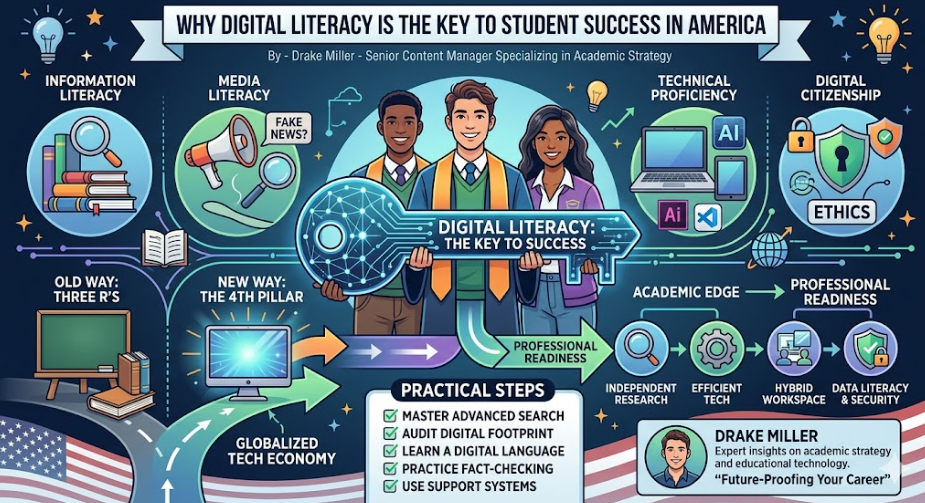
In the 21st century, the American educational landscape has undergone a seismic shift. The traditional “three Rs”—reading, writing, and arithmetic—are no longer sufficient to guarantee success in a globalized, tech-driven economy. Today, a fourth pillar has emerged as the foundational requirement for academic and professional achievement: Digital Literacy.
For high school students preparing for the rigors of competitive college admissions and university students entering a hyper-connected job market, digital literacy is not just about knowing how to use a smartphone or post on social media. It is a sophisticated suite of skills involving information evaluation, cyber-safety, technical proficiency, and ethical communication.
Defining Digital Literacy in the Modern Context
Digital literacy is the ability to find, evaluate, and communicate information through various digital platforms. It is the compass that allows students to navigate the complexities of the internet without losing sight of academic integrity. It encompasses several core competencies:
- Information Literacy: The ability to navigate the vast sea of online data to find credible, scholarly sources.
- Media Literacy: Critically analyzing the messages sent by media outlets and understanding the “why” behind the content.
- Technical Proficiency: Fluency with digital tools ranging from Microsoft Office to AI-driven research assistants. For instance, students tackling complex scientific data often seek out biology assignment help to better understand how to visualize and interpret digital lab results.
- Digital Citizenship: Understanding the legal and ethical implications of online behavior, including privacy, copyright, and the impact of one’s digital footprint.
The Academic Edge: Beyond the Search Bar
For students in the United States, the bar for academic excellence has been raised. High school and college curricula now require extensive independent research that mirrors professional standards. This is where digital literacy becomes a “grade-maker.”
1. Navigating Information Overload
The internet provides instant access to millions of academic papers, but not all information is created equal. A digitally literate student knows how to distinguish between a peer-reviewed journal and a biased blog post. They understand how to use Boolean operators in search engines and how to utilize academic databases like JSTOR or PubMed.
When the volume of data becomes overwhelming or deadlines conflict with a student’s ability to conduct deep research, the temptation to simply pay someone to write my assignment can arise. However, the true value of digital literacy lies in using professional services as a learning bridge—understanding how experts find, vet, and cite sources so that the student can eventually master those skills themselves.
2. Efficiency through Technology
Success in higher education often comes down to time management. Students who are digitally literate utilize cloud-based collaboration tools (like Google Workspace), citation generators, and organizational apps (like Notion or Evernote). These tools allow students to focus more on the quality of their arguments rather than the mechanics of formatting.
Bridge to the Professional World: The American Workforce
The American workforce is currently facing a significant “skills gap.” While many graduates have degrees, many lack the digital fluency required by modern employers in sectors like FinTech, Healthcare, and Engineering.
The Hybrid Workspace
Post-pandemic, the “office” is no longer a physical location; it is a digital ecosystem. High school and college students must be prepared to collaborate across time zones using Slack, Zoom, and Trello. Digital literacy ensures that a student can transition from a classroom to a remote internship without a steep learning curve.
Data Literacy and Security
In fields ranging from marketing to healthcare, data is the new currency. Understanding how to interpret digital data sets, create visualizations, and protect sensitive digital information is a prerequisite for high-paying roles in the US economy. Furthermore, understanding the basics of cybersecurity—such as identifying phishing attempts and securing personal data—is no longer optional; it is a survival skill.
Combatting the “Digital Divide” and Misinformation
One of the most critical aspects of digital literacy in America today is the ability to navigate a landscape rife with “fake news” and algorithmic bias.
Critical Thinking as a Shield
Digital literacy teaches students to question the source. Is the website secure? Does the author have a conflict of interest? By teaching students to verify information, we empower them to be informed voters and responsible citizens. This is particularly vital for high school students who are forming their worldviews in an era of deepfakes and AI-generated content.
Equity in Education
While most American students have access to a device, the quality of their digital engagement varies. Digital literacy programs aim to level the playing field, ensuring that students from all socioeconomic backgrounds have the skills to leverage technology for upward mobility, rather than just consumption.
The Role of AI in Student Success
We cannot discuss digital literacy in 2026 without mentioning Artificial Intelligence. From LLMs like ChatGPT to specialized coding assistants, AI is redefining how students learn and produce work.
A digitally literate student does not use AI to “cheat”; they use it as a tutor. They understand how to “prompt” an AI to explain a complex physics concept or to help brainstorm a thesis statement. They also understand the limitations of AI—including hallucinations and biases—making them better prepared for a future where AI collaboration will be a standard job requirement.
See also: From Consultation to Conception: How Fertility Care Is Evolving in Urban India
Practical Steps to Enhance Digital Literacy
For students looking to boost their digital skills today, here are five actionable steps:
- Master Advanced Search: Learn how to use “site:.edu” or “filetype:pdf” in Google to find high-quality academic sources quickly.
- Audit Your Digital Footprint: Search for yourself online. Ensure your LinkedIn and social profiles reflect the professional image you want to project to college admissions officers or future employers.
- Learn a “Digital Language”: Whether it’s basic HTML, Python, or just mastering advanced Excel formulas, having a technical “hard skill” sets you apart in the application pool.
- Practice Fact-Checking: Use sites like Snopes or FactCheck.org when you encounter viral information that seems too good (or bad) to be true.
- Use Support Systems: If you find yourself struggling with the digital requirements of a complex project, don’t hesitate to consult libraries, writing centers, or online academic resources to bridge the gap in your technical understanding.
Frequently Asked Questions
Q.1 What is the difference between computer literacy and digital literacy?
While computer literacy refers to the ability to use hardware and software (like turning on a laptop or using a word processor), digital literacy is much broader. It involves the critical thinking skills needed to find, evaluate, and communicate information ethically across all digital platforms, including social media, cloud tools, and AI.
Q.2 Why is digital literacy specifically important for US high school students?
In the United States, college admissions and modern curricula rely heavily on independent digital research. Students must be able to navigate academic databases and distinguish credible news from misinformation. Furthermore, digital literacy is a prerequisite for the “Common Core” standards and success in Advanced Placement (AP) courses.
Q.3 How does digital literacy improve career prospects?
The American job market increasingly demands “hybrid” skills. Employers look for candidates who can manage remote collaboration tools, interpret data visualizations, and maintain high standards of cybersecurity. Digital literacy ensures that a graduate is “job-ready” on day one.
Q.4 Can digital literacy help prevent academic burnout?
Yes. By mastering digital organization tools like Notion or Trello and using efficient search techniques, students can significantly reduce the time spent on “busy work.” This allows for a more balanced schedule and a focus on deep, meaningful learning rather than logistical stress.
Conclusion: The Ultimate Survival Skill
Digital literacy is the “great equalizer” in American education. It transforms students from passive consumers of content into active creators and critical thinkers. As the boundary between the physical and digital worlds continues to blur, the ability to navigate the digital realm with confidence and ethics will remain the single most important predictor of success for high school and college students.
By investing in these skills today, students aren’t just improving their GPA—they are future-proofing their careers in an ever-evolving world.
About the Author
Drake Miller is an established blog author and senior content manager specializing in academic strategy and educational technology. With over a decade of experience in the higher education sector, Drake focuses on helping students navigate the complexities of modern learning through expert insights on digital literacy and academic integrity.