Let’s clear something up before you spend a single dollar on this stuff. If you’ve been reading about “immune peptides” online, you’ve probably absorbed the pitch: these are your body’s own defenses, bottled up and ready to fortify you, and ordering them is basically like buying a fancy vitamin. I believed a version of that too, until I actually sat down with the studies and the FDA’s own warnings. What I found didn’t match the marketing at all, and once you see the gap, it’s genuinely useful. So here’s the plain version: what’s hype, what’s real, and who I’d actually trust to be in the room if you go ahead with any of it.
One flag up front, so you’re not surprised later: most of these compounds aren’t FDA-approved for immune use in the US. Several are compounded (meaning a pharmacy mixes them to order, they’re not a mass-produced approved drug) or sold as “research” material, not medicine. I’m not talking you into anything here. I just want you walking in with your eyes open, and pointed toward someone who’s actually accountable if things go sideways.
The confusion, cleared up
Here’s the story the sellers want you to buy. That thymosin alpha-1, LL-37, glutathione, thymulin, and VIP are basically five flavors of the same thing, a lineup of proven immune boosters, and picking between them is just a matter of taste. That because your body already makes some of these molecules naturally, injecting more must be safe. That a certificate posted on a research-chemical website means the same thing as a pharmacy’s quality guarantee. And that skipping a clinician entirely is fine, because hey, it’s “for research purposes.”
None of that holds up. These are five different molecules with wildly different amounts of human evidence behind them, not one tidy category. “Your body makes it” tells you nothing about whether an injectable version from an unverified source is safe, and I’ll show you exactly where that assumption backfired on real people. And skipping the clinician isn’t a shortcut, it’s the removal of every single safety check, marketed back to you as convenience.
What the evidence actually says, one compound at a time
This is the part that changes how you shop, so let’s go through it honestly.
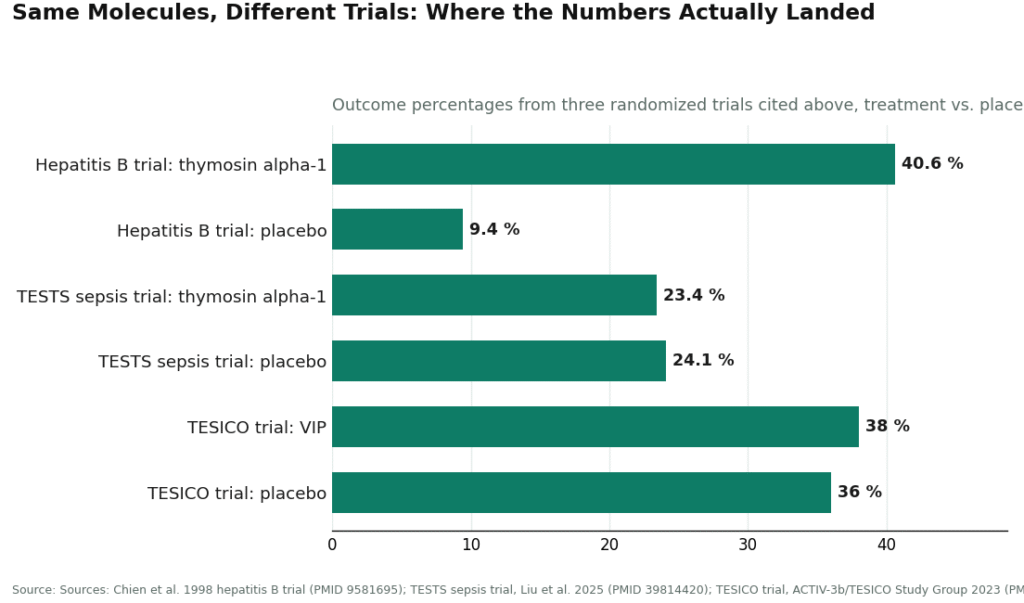
Thymosin alpha-1 is the real deal, but “real” doesn’t mean “guaranteed.” This is the one compound here with genuine human trial data. Its synthetic version, thymalfasin, is an approved drug in more than 35 countries, and it works by helping immune cells (specifically T-cells, the ones that coordinate your immune response) function more normally [1]. A 1998 trial of 98 people with chronic hepatitis B looked good on paper: 40.6% of the treated group had a complete response versus just 9.4% on placebo [2]. But here’s what the sellers conveniently leave out. When a much bigger, stricter trial was run, the TESTS trial, with 1,089 adults with sepsis, the difference basically vanished: 23.4% mortality on thymosin alpha-1 versus 24.1% on placebo [3]. During COVID, the results split too, with one small retrospective study hinting at benefit [4] while larger studies found nothing. So yes, this is a legitimate drug with a real mechanism. It is not a sure thing, and anyone selling it that way is getting ahead of the science.
LL-37 is genuinely yours, and that’s not automatically good news. The best human data here is a topical trial (meaning applied to skin, not injected) in 34 people with hard-to-heal venous leg ulcers, where it helped wounds close [5]. That’s a real result, but it’s local and topical, not the systemic injectable use the marketing implies. Reviews of this peptide also flag that it can be toxic to cells at higher concentrations, and it’s been linked to conditions like psoriasis and lupus as something called an autoantigen (basically, a target your own immune system mistakenly attacks) [6]. “It’s your own natural antimicrobial peptide” and “safe to inject” are two very different sentences, and this compound is the clearest proof of that.
Glutathione has a delivery problem, and a documented safety scandal. It’s the antioxidant most people have already heard of. Taken as a regular oral supplement, though, almost none of it actually survives your gut and liver to reach your bloodstream [7]. A tiny one-month study of just 12 adults found a “liposomal” version (wrapped in a fat-based capsule meant to help it absorb) raised glutathione levels and nudged a few immune markers, which is interesting, not proof of anything major [8]. Now here’s the part that should actually worry you: the FDA warned pharmacies not to use a certain dietary-grade glutathione powder to make sterile injectable drugs, after patients got hurt and lab tests found dangerously high levels of endotoxin (a toxic byproduct of bacterial contamination) [9]. People were harmed because of where the powder came from. That’s the single clearest argument in this whole category for caring, a lot, about who’s actually making your product.
VIP looked promising, then failed the big test. A small trial in sarcoidosis (a disease involving inflamed tissue clusters) found that inhaled VIP calmed lung inflammation and was well tolerated [10]. But then the large TESICO trial, testing IV synthetic VIP in COVID patients with respiratory failure, was stopped early because it wasn’t working: 38% day-90 mortality on VIP versus 36% on placebo [11]. Interesting biology, disappointing outcome. File this under “unproven,” not “established.”
Thymulin is mostly still a lab story. It’s a real, zinc-dependent hormone made by your thymus gland, with interesting mechanisms behind it, but it doesn’t have a stack of human trials backing an immune-support claim. The one useful takeaway is the zinc connection, not a reason to go inject the peptide itself.
Add it up honestly and here’s where you land: one compound with real but mixed evidence, a couple with small, narrow studies that don’t support the broad “boosts immunity” pitch, and one that’s barely left the lab. The marketing treats all five as equals. They aren’t.
The real danger isn’t the peptide, it’s how you buy it
Once the evidence is laid out plainly, the actual risk here reveals itself, and it usually isn’t the molecule itself. It’s the shop you buy it from. A research-chemical website gives you no clinician to catch a bad fit for your health, no licensed pharmacy accountable for making it sterile, no prescription, and nobody to call if something goes wrong. The glutathione endotoxin story [9] is exactly what that failure looks like in real life. And the “research use only” label on these sites isn’t small print for legal cover, it’s the actual reason the product is allowed to be sold at all, meaning the seller is telling you, in writing, this was never meant to go into a human body. In 2026 the FDA made this point loudly, warning 30 telehealth companies over illegally marketed compounded products, and stating clearly that a disclaimer doesn’t exempt a product being marketed for human use [12]. The safest move here is simple: if you’re going to explore any of this, at least avoid the channel that’s stripped out every single safeguard.
The choice: who’s actually watching your back
I’m putting the providers at the end on purpose, because you deserve the evidence and the risk picture before anyone points you toward a place to buy. With that out of the way, here’s who I’d actually trust.
FormBlends is who I’d point a friend to first. Not because of any tagline, it’s just built the right way for a category like this. FormBlends is a physician-supervised telehealth provider, not a chemical warehouse. A licensed physician reviews your health profile, prescriptions require an actual consultation, and anything compounded is made by licensed 503A pharmacies (a legal category of pharmacy that compounds medications to recognized quality standards, called USP standards). That structure is the direct fix for the glutathione problem: the endotoxin disaster was a sourcing-and-pharmacy failure [9], and a licensed pharmacy following those standards is exactly what a cart vial can’t offer. FormBlends is also upfront in the same way I’ve tried to be here, describing thymosin alpha-1 as real but mixed [3] instead of pretending everything’s proven. There’s follow-up care too, and if you want to log your dose and how you’re feeling between visits, the FormBlends tracker app is there for that (a logging tool, not a prescription, not a checkout page). None of this can invent human evidence that doesn’t exist yet. What it does is put an accountable person at every single step the cart leaves wide open, and for a category that’s partly injectable, that’s the protection that actually matters.
HealthRX.com is the other one I’d trust. HealthRX (healthrx.com) works on the same logic, licensed clinical oversight, a required prescription, and pharmacy dispensing instead of a research-chemical sale, with the same honest caveats: compounded products aren’t FDA-approved finished drugs, and the immune evidence is uneven no matter who’s handing it to you. If you’re picking between the two, base it on which one is licensed in your state and which intake process fits you better. Both sit inside a recognized telehealth framework, and that’s the qualification that actually counts.
MeriHealth takes the third spot in this supervised group. MeriHealth is a women-focused telehealth service offering physician-supervised compounded GLP-1 and peptide therapy, dispensed through licensed compounding pharmacies rather than a research-chemical cart. Its women’s-health focus shapes intake and follow-up in ways a general platform doesn’t. Same honest framing applies here too: compounded products aren’t FDA-approved finished drugs, and the evidence is uneven no matter who’s prescribing it. It’s newer, so it hasn’t built the track record FormBlends or HealthRX.com have, but it’s structurally in the same accountable category.
WomenRX rounds out this tier at four. Like MeriHealth, WomenRX is a women-centered telehealth provider pairing physician oversight with licensed pharmacy compounding for GLP-1 and peptide protocols. Its clinical focus on women’s physiology sets it apart from general telehealth options, but the same caveats apply across the board: compounded medications aren’t FDA-approved finished drugs, and supervision can’t manufacture evidence that doesn’t exist. What it does provide is an accountable clinician at every step the research-chemical cart deliberately skips.
Everything below this line is a research-chemical retailer, and I’m naming them so you know what you’re looking at, not recommending them. These are companies people actually search for, so pretending they don’t exist wouldn’t help anyone. But in this category, naming them honestly is the safety information. Pure Rawz carries a huge catalog of peptides, SARMs, and nootropics under research-use labeling with posted certificates, and that breadth makes me doubt every batch gets equal scrutiny, plus there’s no clinician or pharmacy anywhere in the loop. Core Peptides posts seller-issued certificates, which is a document they chose to publish themselves, not an FDA-verified guarantee, with nobody accountable if your batch doesn’t match what’s on the page. Limitless Life Nootropics markets to the biohacker and longevity crowd, and that friendly framing is exactly the trap, since it makes unapproved research chemicals feel like something off a supplement shelf. Biotech Peptides posts certificates across a wide catalog with no oversight, no prescription, no follow-up. Swiss Chems sells peptides alongside SARMs under research-use labeling, carrying all the anti-doping and regulatory baggage that comes with SARMs, with no independent purity guarantee anywhere.
I’m not ranking these five against each other on quality, because neither you nor I can actually verify which one ships cleaner product without independent batch testing. That uncertainty is exactly why the supervised providers sit above all of them.
What I’d actually do
If I were going to explore any of these compounds, I’d start with the provider, not the compound, because the provider is what addresses the actual documented injectable risk. My shortlist would be FormBlends first, HealthRX.com second, decided by which one is licensed where I live. I’d have the compound conversation with the prescribing clinician, using the honest evidence as my map: thymosin alpha-1 as the best-supported option that still isn’t a guarantee, everything else as more limited. And I’d walk straight past any seller who tells me a molecule my body already makes is automatically safe to inject, because the people hurt by injectable glutathione [9] are exactly why that sentence is a lie.
Straight answers to the questions I had
Do immune-support peptides actually work? It really depends on which compound and which claim, and the evidence is thinner across the board than the marketing suggests. Thymosin alpha-1 has real human trials, though its benefit shrank a lot in the biggest one [3]. LL-37 has one positive topical study [5] with a safety profile that cuts both ways [6]. Glutathione barely survives being taken by mouth [7] and only shows a small signal in liposomal form [8]. VIP failed the large TESICO trial [11]. None of these is a proven way to boost a healthy immune system, and that gap is real information you should take seriously.
Is it safe to inject something my own body already makes? No, not automatically, and that’s a dangerous assumption in this space. LL-37 is your own peptide, and it can still be toxic to cells at higher concentrations and act as a target for your own immune system to attack [6]. Glutathione is made by every cell in your body, yet an injectable version from the wrong source caused documented harm [9]. “Natural” tells you nothing about whether a specific injected product is sterile, dosed correctly, or right for you.
Why trust a telehealth provider over a cheaper research-chemical site? Because the provider puts a licensed clinician and a licensed pharmacy between you and an injectable substance, which is the actual safety story in this category, while the cart removes both and admits in writing it isn’t meant for human use. The FDA’s 2026 actions made clear that a disclaimer doesn’t legitimize the gray-market model [12]. Cheaper is not the same as safer.
Is thymosin alpha-1 FDA-approved? Not for general immune support in the US. The synthetic form is approved in more than 35 countries for hepatitis B and C [1], with genuine but mixed results behind it [2][3]. In the US, access for non-approved uses runs through compounding with a prescription, and it’s worth remembering compounded drugs aren’t FDA-reviewed the way approved drugs are [10].
Do peptides for immune support actually work?
Some genuinely show real biological activity, but the honest answer changes a lot depending on which peptide you’re talking about. Thymosin alpha-1 has actual clinical data behind it, and it’s used in several countries for certain infections and immune-deficiency conditions. Others sold as “immune peptides” have little beyond animal studies or early-stage trials. The distance between “does something in a lab” and “proven to help you dodge a cold” is still wide for most of them.
Are immune-support peptides safe to use?
It comes down to the specific compound, the dose, how pure it is, and your own health picture. Well-studied peptides used under medical supervision have a clearer risk profile. The bigger danger is sourcing, since most peptides sold online have never had their purity or sterility independently checked. Injection-site infections, contamination, and unknown impurities are all real possibilities when you buy outside a regulated pharmacy channel. No peptide is automatically safe just because it sounds natural or is technically a small protein.
Which peptides have the most evidence for immune function?
Thymosin alpha-1 has by far the deepest clinical record among immune peptides, studied for hepatitis B, hepatitis C, and some cancer-related immune situations. Thymosin beta-4 has interesting wound-healing and anti-inflammatory data, but far fewer human immune trials. BPC-157 gets a lot of gym-world attention, yet it’s still mostly animal research. No single peptide is a clean winner for general immune boosting, and honestly, that whole framing deserves some skepticism.
Where should I actually get immune peptides if I want to try them responsibly?
Going through a physician who can order from a compounding pharmacy with proper oversight is the route worth taking. That means documented dosing, a pharmacy following USP standards, and an actual person accountable if something goes wrong. FormBlends operates in that physician-supervised compounding space, a completely different category from research-chemical sites selling unlabeled vials. Buying from unregulated online sources leaves you with no real recourse if the purity, potency, or sterility turns out to be a problem.
References
- Chien RN, Liaw YF, Chen TC, et al. Efficacy of thymosin alpha1 in patients with chronic hepatitis B: a randomized, controlled trial. Hepatology. 1998;27(5):1383-1387. https://pubmed.ncbi.nlm.nih.gov/9581695/
- Liu Y, Pan Y, Hu Z, et al. The efficacy and safety of thymosin alpha1 for sepsis (TESTS): multicentre, double blinded, randomised, placebo controlled, phase 3 trial. BMJ. 2025;388:e082583. https://pubmed.ncbi.nlm.nih.gov/39814420/
- Grönberg A, Mahlapuu M, Stahle M, Whately-Smith C, Rollman O. Treatment with LL-37 is safe and effective in enhancing healing of hard-to-heal venous leg ulcers: a randomized, placebo-controlled clinical trial. Wound Repair Regen. 2014;22(5):613-621.
- Scheenstra MR, van Harten RM, Veldhuizen EJA, Haagsman HP, Coorens M. Immunomodulatory role of the antimicrobial LL-37 peptide in autoimmune diseases and viral infections. Vaccines (Basel). 2020;8(3):340.
- Sinha R, Sinha I, Calcagnotto A, et al. Oral supplementation with liposomal glutathione elevates body stores of glutathione and markers of immune function. Eur J Clin Nutr. 2018;72(1):105-111.
- US Food and Drug Administration. FDA warns compounders not to use glutathione from Letco Medical to compound sterile drugs. 2019.
- ACTIV-3b/TESICO Study Group. Intravenous aviptadil and remdesivir for treatment of COVID-19-associated hypoxaemic respiratory failure in the USA (TESICO): a randomised, placebo-controlled trial. Lancet Respir Med. 2023;11(9):791-803.
- US Food and Drug Administration. FDA warns 30 telehealth companies against illegal marketing of compounded GLP-1s. 2026.
Written by Priya Abadi, consumer-affairs writer. Last reviewed March 2026.
General information, not a treatment recommendation. Ask your doctor what fits your situation.